
There’s so much hype about percolation drippers that it’s almost uncool to say that you like immersion. While recent steep-and-release brewers have changed the dynamics to some extent, I still think there are aspects of extraction in immersion we often overlook – a grave dug by the concept of immersion itself.
A rather clever idea
The first time I heard about Clever Dripper was at Rook Cafe on the premises of Little Silver Station in its namesake town in New Jersey. I stood fascinated as the barista’s workflow involved just discarding used paper filters and grounds in one go, putting in and rinsing a new one, pouring grounds and water, and draining it after the timer went off. Till date I haven’t seen a more convenient manual filter brew workflow whether in a cafe or at home.
My urge to first buy a clever dripper came about in 2017 when an online publication (one whose name I can’t remember) touted its advantages over the humble french press and also existing percolation brewers (which were less than a handful back then). Since the french press was my goto in 2017, that specific write-up was enough to convince me that I should splurge USD 22 on one (it was cheaper back in the day). In retrospect, the design of a clever dripper for the time that it was first released (circa 2008) was frankly ingenious.
I came to this realization fairly recently though, when I brewed in a french press and tried pouring the strained brew through a V60 filter. I stood in shock as the brew took several minutes to drain, showing just how easily a fairly porous filter like a tabbed v60 can be easily choked by the few fines in a strained french press brew. In fact if you try doing Lance Hedrick’s USBrC routine at home, you’ll notice just how long the brew takes to drain in absence of a coffee bed in direct contact with the paper filter. What if instead you could filter a french press brew using a coffee bed and a paper filter? What if you didn’t have to go all the way to a specialty coffee shop or some obscure online website (we’re talking 2008) to get your hands on a paper filter, and instead just use trapezoidal paper filters that are commonly available (Melitta size 4) in arguably most grocery stores? What if you used a similar mechanism to block flow that’s present in most cheap coffee makers, but instead adapt that for wider lipped carafes? I don’t blame them for labeling it after a “clever” idea.
The Aeropress problem
There’s no point denying that the aeropress has been the most popular brewer of choice in the last couple of decades. It was already widely available prior to clever dripper, was frankly more portable than a clever dripper, and had a whole championship built around it that essentially started for fun. Talk about free marketing.
Meanwhile, the clever dripper had some inherent shortcomings – it was meant to be kept in one place, wasn’t exactly as sleek looking as the aeropress, and was plagued by the low porosity of available filters. This is one domain in which the aeropress excelled – at the cost of having a nominal amount of fines in your brew, applying pressure to have a column of water pass through a bed under tiny amounts of pressure does some amazing things – it allows the fines that would have otherwise clogged your filter to be pushed out into your cup instead, while also trapping most of them in the coffee bed (the greatest filter ever made).
Folks tried different ways to get around this over time. For example some adopted specific brands of trapezoidal filters like Filtropa (they tasted less papery to me than Melitta but still papery). Mat North used V60 filters instead – this was probably my favorite hack because it allowed one to use the most commonly available high porosity filters (yes, you can very much use v60 filters in a clever dripper), and a size 03 v60 tabbed filter is still my filter of choice for situations where other non-grocery-store options aren’t available. But despite all this, if you ever tried pouring with a kettle stream onto a coffee bed in a clever dripper, you’re bound to get a super-long drawdown.
The water-first generation
James Hoffmann can arguably be credited for making the water-first technique popular (he in turn credits Workshop Coffee for the idea, although I’m sure as is quite common in the coffee world, other folks might have come up with it independently). This to me was a bit of a gamechanger. Putting brew-water in first, then the coffee and gently saturating the coffee at the top of the slurry with a spoon or wdt meant that you don’t end up migrating much fines and at the end of your steep, the brew drains faster than you can say “clever-dripper”. To be honest, this approach was my gateway back to tasty filter coffee when I was in a filter coffee slump (all my espresso was consistently tasting significantly better than my filter brews).
There was one problem though – if you are the kind who cares about efficiency of extraction beyond just taste, you’ll be in for a rude shock. The water-first technique isn’t really efficient at extracting reasonably high in a consistent manner. My hunch is that this is both due to lack of agitation preventing grounds from mixing with the brew-water sufficiently, and also due to the “deadspace” water at the bottom of the brewer. That’s the water that sits below the coffee bed without being in contact with it, thus not getting much solubles out of it. Depending on the filter you use, this can be anywhere between 10-30 ml, which is not a trivial amount.
An astrophysicist enters a coffee bar
In his now famous blog post on aeropress, Jonathan arguably made the idea of a long-steep immersion brew broadly acceptable. In addition, this idea of a long-steep immersion worked pretty well with a clever dripper when doing the water-first approach. It made for a hands-off brew, which would be hard to mess up even if you missed your target water weight, or were off a little bit on grind size.
However I chose to do things differently in terms of ratio when it came to the long steep. In my mind, the difference in extraction yield (EY) between a percolation and immersion brew wasn’t just due to steep duration, but also because we’re giving the grounds a fresh supply of water as the brewed coffee drains. So not only are you extracting faster, but you’re also using less water. The opposite of this would be to use not just a longer steep duration, but also a longer brew ratio, and a slightly finer grind than you would for percolation. One late night when I needed to stay awake but only wanted to brew 10 grams of coffee, I attached my prismo to the aeropress, poured in 180 grams of water, steeped it for 8 minutes, and pushed the plunger in a way that it takes about a minute for the brew to percolate out the aeropress. It was the most magnificent immersion brew I’d had uptil then.
The tds sacrifice
While this resulted in a pretty decent EY number, I had sacrificed on tds. Gone were the 1.3-1.5 tds brews I would get from percolation or low ratio immersion. Instead these were brews in the range of 1.2-1.4 tds, but significantly more tasty than what I was getting from low ratio immersion brews. Every nuance of the roast (in the above late night case a well executed roast of coffee from Kahunyo washing station, Kenya by Nomad) exploded in my mouth and lingered for hours. I don’t think it was the caffeine that kept me awake late that night, but rather my memory of the coffee I’d just had, which probably also resulted in me not getting the work done that I’d had coffee for in the first place.
There was something interesting that happened when I did a long-ratio-long-steep (LRLS) when doing water-first in a clever dripper though. Not only was it extracting less than an aeropress (even if I normalized for reduced liquid-retained-ratio of an aeropress), but the clever dripper brews ended up with significantly more body than the aeropress brews. On the other hand, when brewed with coffee going in first and then pouring with a kettle to cause agitation and saturation, the flavor profile was much more close to what I was getting with the same recipe in an aeropress, albeit with a significantly longer drawdown (and also with EY matching that of aeropress if I normalize for LRR). While the increased body (in water-first approach) by itself wasn’t a negative because the taste was still intricate and tasty, it still made me think long and hard about why two immersion brewers with the same recipe would taste this different.
Your best friend the coffee bed
My pocketscience hunch as to what’s happening is that the coffee bed not only filters fines and astringent compounds, but also compounds that are responsible for body perception in coffee. By doing water-first near-zero agitation, not many fines migrate to the filter, and thus more of the brewed coffee can bypass the coffee bed, in turn allowing more body compounds to get into the final cup, instead of being filtered by the coffee bed.
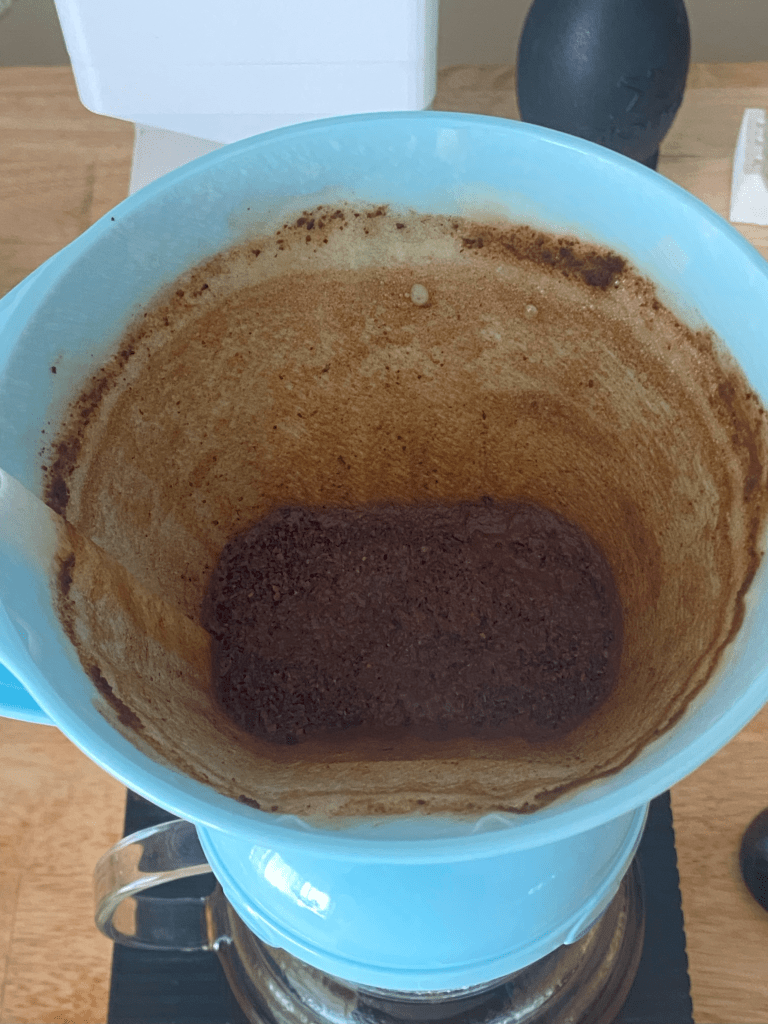
Another alternate possibility is that the extraction that happens with coffee first and then the kettle stream coming in and agitating while dislodging fines, is that the compounds extracted with help of said agitation changes the flavor profile in a way that body compounds are less perceivable. I do not understand chemistry or sensory science enough to be confident about either theory, although my intuition says the former theory of bed filtration is more probable based on similar findings in my v60 recipe exploration.
What about actual filters
This, more than anything else is the clever’s biggest drawback. While the dripper’s design allows for bypass, an agitated brew is always going to be restricted by filter pores clogged by fines and be forced to pass through the bed. This sometimes can be a blessing in disguise for someone like myself who’s getting kids ready in the morning in zombie state and just has about enough energy to put some coffee and water in a brewer without wanting to think about extraction dynamics. However on days when I wanted that cup of brewed coffee sooner than the drawdown allowed, I would feel frustrated.
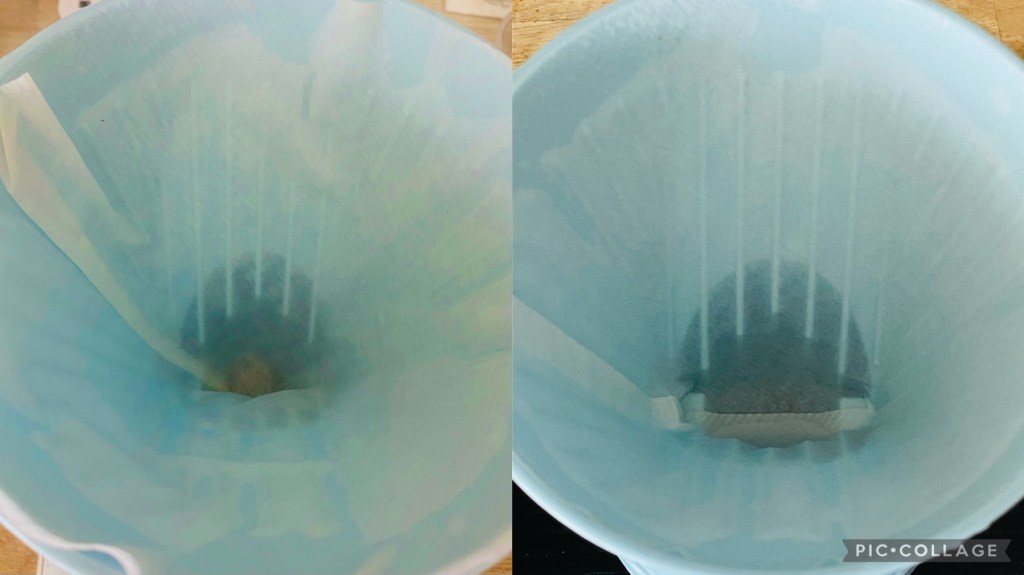
While grinders, burrs and brewers are the ones getting attention for the gazillion options that have flooded the market, I feel like the market for filters has also changed radically, just without getting as much exposure, arguably due to being less photogenic. The surge in options has undoubtedly been due to the wide range of porosity options that Cafec has come up with, especially in the conical filter range. In fact the Cafec Medium T-90 filters (among the most porous filters on the market) did alleviate the drawdown issue in the clever to some extent. But more recently I was pleasantly suprised to find that they have trapezoidal filters in their Abaca lineup. Specifically the Abaca 103 are an excellent fit in the clever dripper, and seem to have decent porosity, but not nearly enough to speed up drawdown when done with the coffee-first approach.
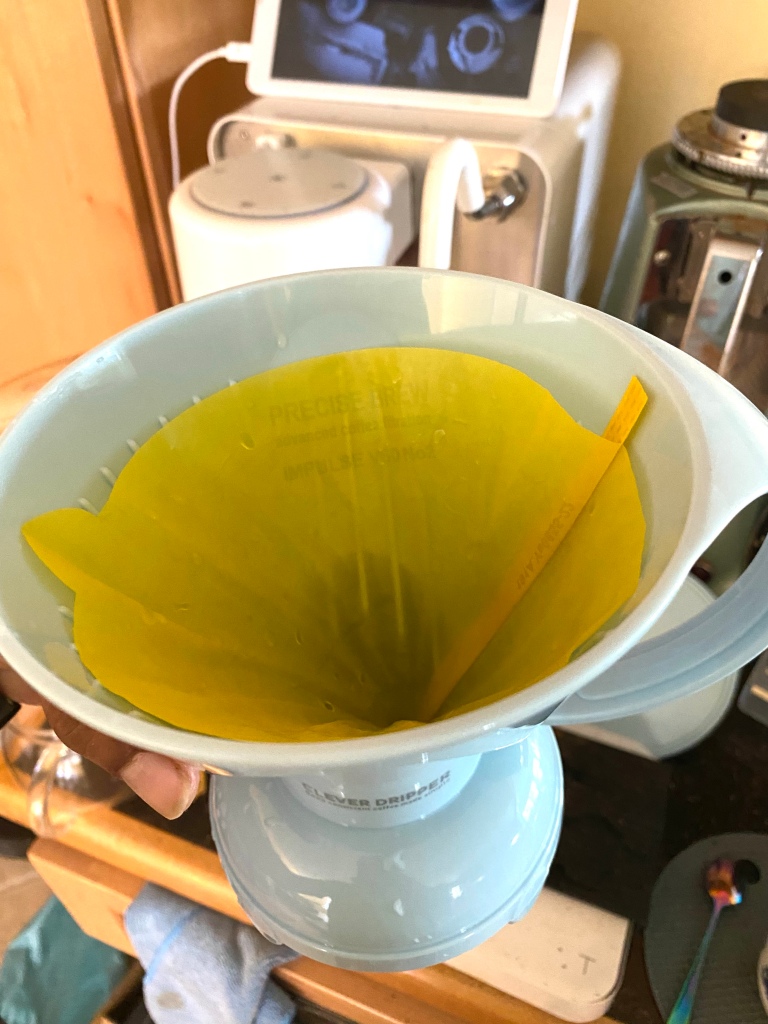
More recently Precise Brew came out with filters with pore sizes between 20-25 um made of a proprietery polymer material that they claim can be reused upto a 1000 times. The porosity of these turned out to be a bit more than Cafec Medium T-90 filters. While these did okay in terms of drawdown time, there was a distinct flavor that the filters seemed to impart to the brew. Between that and the effort spent in rinsing and drying (and maybe even ultrasonically cleaning it if you wanted a more thorough cleaning), to me it didn’t seem worth the effort. Note that the filter shown in fig. 3 isn’t designed for a clever dripper and I’d recommend getting their trapezoidal filter if you go the route of Precise Brew filter in clever dripper.
Is a spoon the next kettle
A few days ago as I was aimlessly pondering as to which way I should go so as to get the best of both worlds – put coffee in first to get high yield with sufficient agitation and saturation or put water in first to get a fast drawdown. Using a WDT when doing coffee-first would not be sufficient since most don’t have needles deep enough and in turn that makes it an accessibility issue. Also there’s no guarantee that I can move the slurry around enough to mix it to the extent I want with grounds at the bottom.
With a cupping spoon or tablespoon though, one can create just about enough water movement to recirculate the deadspace water while getting more grounds from the bottom into the slurry, just that one needs to be super gentle instead of being aggressive. Lance Hedrick’s spoon bloom saturation was undoubtedly at the back of my mind when I was thinking about this. It’s about to be a cliche at this point the number of brewing techniques that one simple thing has spawned off.
And that right there was the missing bit. Even with high fines coffees, I was getting drawdowns that, while not exactly as fast as a water-first approach with minimal agitation, it wasn’t too far behind and definitely significantly faster than the coffee-first approach. Not only was I getting the same yield as the coffee-first approach, I now had the benefit of being able to have a cup ready much quicker, and an 8 minute steep time could now be conveniently adjusted to shorter steep times by changing grind size to compensate for contact time (I like to think of approaches that are more practical in a cafe setting, despite being a home barista). As Christopher Feran would tell you, “No need to faff with a v60, just go make a bagel on the side instead.”
The busy-dad recipe
Each morning when feeding my kids or getting them ready to go about their day, I do the following to make a stellar cup of coffee with less than my whole brain functional:
- Grind 15-20g of coffee at about 550 um from lock
- Boil water
- Put filter of choice in clever dripper. Hold under tap water to make it snug against the dripper walls
- Pour 18x times dose of brew-water into clever dripper
- Dump ground beans into water
- Take a cupping spoon or tablespoon and gently move it in the slurry in a scooping motion as deep as you can while going as deep as you can
- Set your timer to 8 minutes and hit start
- At the end of 8 minutes, place the dripper on your carafe and let it drain
- Enjoy a low-effort delicious cup of coffee.
Some possible variations depending on what the situation demands:
- When dealing with a roast that’s more developed than you like – reduce both steep duration and ratio (extent will depend on what you dislike about a given roast). Maybe even grind coarser if you still don’t like it.
- If despite everything drawdown takes very long – grind 50 um finer and reduce steep duration to 6 minutes to get a similarly stellar cup of coffee.
- If you desire even lesser body, just do the coffee-first approach and live with the long drawdown.
- If using an aeropress, I’d just do coffee-first and then do a super-slow plunge (maybe about a minute long)
- If you ground finer by mistake, reduce steep duration
Why clever over switch
With the Hario Switch having been around for a while and having gained popularity for being a forgiving brewer, one might ask why one should consider the clever. Two of the biggest reasons for me are that at a similar pricepoint, I’m getting both a plastic brewer and a larger volume. I have never quite been able to get vibrant enough brews from a switch, no matter how hard I tried to push extraction. Not to mention, I absolutely love how more recent color variations look on the clever (pastel blue obviously being a winner for me). In my mind the clever dripper still holds an advantage when it comes to cafe workflow if one desires convenience, yield and taste.
Also if you’re wondering whether this closely resembles a cupping, you’re absolutely right! There’s a reason why cupping is the only brewing approach that beats the clever in terms of convenience. In fact, my cupping recipe is the same as clever, except for grind being 50 um finer to get similar yield at the same ratio (something that I think might have to do with my cupping brew volume being much smaller and also the bowl being more prone to both heat loss and evaporation).
It’s quite telling that while I’ve given up on using some brewers despite having gotten fair results from them, I’ve only ever loved the clever more over time.
Acknowledgements
- Christopher Feran and Mat North for not giving up on the clever dripper
Subscribe to keep your pocket updated with coffee science.


 Pocket Science Coffee
Leave a comment